
Hacksaw Ridge: An Epic of Christian Faith and Heroism
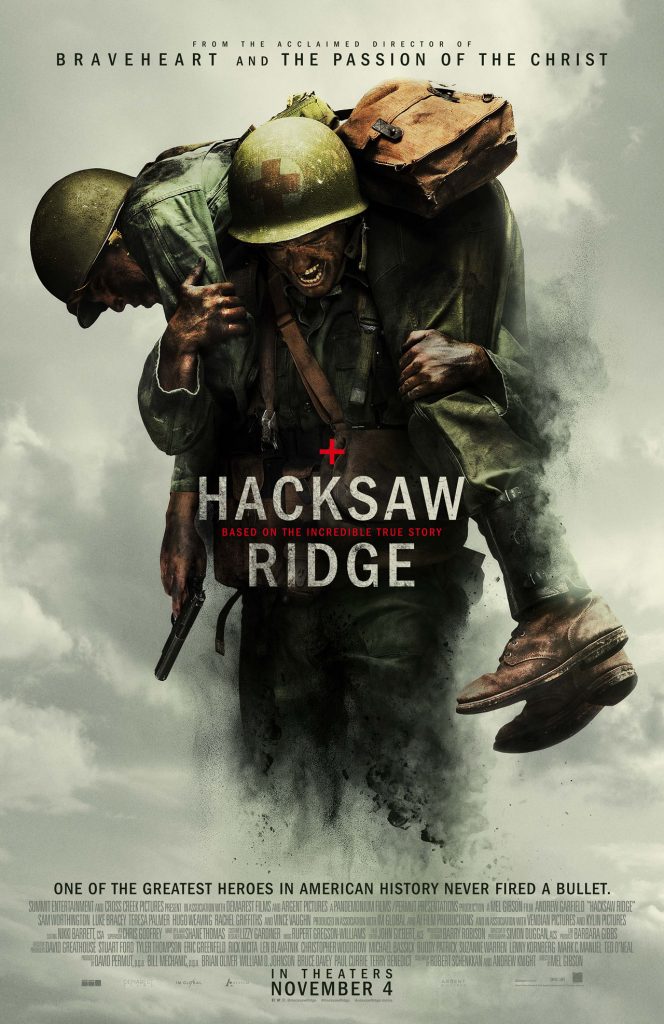
I just saw Hacksaw Ridge again. I posted about an early screening, and I am reposting that with expansions here.
It’s the true story of Desmond Doss, a Seventh Day Adventist Christian who joined the US military in WWII, but refused to carry a weapon and never fired a bullet. He became a medic who “saved lives instead of taking lives.” He suffered persecution within the system and from his fellow soldiers, but ended up saving 75 of his company’s men in the brutal bloodbath of Hacksaw Ridge on Okinawa.
This is the best war movie about Christianity in a time of war since To End All Wars (Go ahead, mock me, accuse me of self-promotion, but it’s true, regardless of who wrote it. And it was a true story too).
Mel Gibson’s Redemption
He’s done it again. Mel Gibson has crafted one of the most inspiring movies for this generation.
If you want to see Christianity respected in a movie, then you will definitely want to see Hacksaw Ridge.
If you want to see Christianity lived out in grace and sacrifice, then you will definitely want to see Hacksaw Ridge.
If you want to be inspired to be a better person, then you will definitely want to see Hacksaw Ridge.
And here is what is amazing. Gibson wants to do as much as he can to appeal to the Christian audience, without compromising his artistic vision. Something you didn’t see Aronofsky or Ridley Scott give a damn about. Gibson cut out all F-bombs and “taking of the Lord’s name in vain,” in response to Christian concerns. (Now, I happen to think that those demands by the Christian audience are actually unbiblical, but they are nevertheless demands of the demographic, and Gibson respects his audience.).
Be aware though, this is about love and sacrifice in a world of great pain and suffering, so there is a lot of the violence, blood and gore of war to illustrate that redemptive power. Fortunately, Christian viewers are less consistent in their acceptance of movie violence, and don’t have as big a problem with it.
Moral Complexity
I am not a pacifist. In fact, I am convinced that Desmond’s pacifism is thoroughly and utterly unbiblical. BUT his actions were thoroughly heroic and utterly Biblical. In that sense, Desmond wasn’t really a pure pacifist, because he supported and aided those who did kill others.
But his heroism was in sacrificing himself to rescue others, even after they had rejected him.
A heroism that is both inspiring and convicting. I still get chills just writing about it.
And that is what makes the story so fascinating. Gibson’s genius storytelling is his ability to wrestle with a morally complex issue and shake out existential truth from the real world clash of opposing ideas.
Because of its respect for both sides of opposing viewpoints, both veterans of war AND haters of war will love this movie. Left and Right will love it. It will force both pacifists and just war advocates to re-evaluate their own beliefs, and hopefully inspire civil conversation (As Desmond would have wanted).
It does what good art should do, inspire more thought and conversation about transcendent truths like courage, sacrifice, standing up to evil, loving your neighbor, loving your enemy, and of course, the most important of all: loving God.
Pacifism Vs. Just War
A friend of mine said that he felt Gibson glorified war too much with its melodramatic music over slow motion close ups of the rallying battle at the end, and other over the top touches. I disagreed. As I see it, those who would strip the creative embellishments on such moments would willingly or inadvertently create a nihilistic denial of transcendence that such art provides. The heightening of reality through emotional style helps to imbue our understanding of a very painful imminent suffering with the transcendent meaning that cannot be seen by mortal eye.
And that is what the righteous violence of self-defense and just war achieves: transcendent redemption. War is not hell, and it is not insane, as most pacifist and secular movies now portray. Sadly, like Desmond, they only think that way because they have a simplistic Manichean lack of complexity in their understanding of reality. I wrote about this phenomenon of war movies years ago here.
The naivete is expressed in Desmond’s argument in the movie when an officer correctly points out that the commandment that Desmond is following, “Thou shalt no kill” is actually, “Thou shalt not murder” which means, not ALL killing is wrong. Murder is the unjust taking of innocent human life. Just taking of guilty life through self-defense or just war or capital punishment is what the Bible does condone. Desmond responds that Jesus gave us a new commandment to love one another, as if somehow God’s Law is invalidated by the New Covenant. This kind of good-hearted ignorance is what actually gets millions killed, as it did with Neville Chamberlain’s pacifist lack of standing up to Nazi evil.
In the movie, the tragic inconsistency of pacifism, and therefore moral complexity of the story, is displayed when we see the meanest fighter of the bunch end up being a guardian angel of Desmond. As Desmond rushes in where angels fear to tread to save human lives on the battlefield, his fighting buddy follows him, shooting all the Japanese who attack him. You just simply can’t save, or protect people from violence without righteous violence.
Ironically, then, Desmond saves that guardian angel later from his own demise. So the balance is found in BOTH saving the wounded and killing the guilty. It wouldn’t work any other way. And thus the pacifism of Desmond Doss was not a consistent one. That is why I could accept his contradiction, because in spite of his own lack of violence, he was willing to sacrifice his own life and help those who were engaging in righteous violence. Pacifism is subverted.
Godawa’s Quibble Corner
One of the reasons why this movie is so transcendent is because it wrestles with a strong moral issue through an imperfect character. Heroes in the real world are people who may have strong convictions or produce profound art, but don’t necessarily live exemplary lives themselves. Or even, as in Desmond Doss’ case, believe ridiculous things. But the courage of his convictions is what draws our souls to stories such as this.
I used to think Seventh Day Adventism (SDA) was just another typical denomination with its quirky distinctives, but remaining a part of the orthodox tradition. But recently I had to look into it because of a personal connection to someone involved in it. Wow, I discovered a cultish community so wrapped up in some bizarre doctrinal abberations that I had to conclude it is quite a spiritually dangerous church. Of course, like all religious groups, there are varieties of beliefs within the denomination. Not everyone in the SDA follows Ellen White as a prophet with the same devotion or intensity. Some beliefs have variances, but the overall picture is not good.
I don’t want to rant about their legalism or their false prophet Ellen White or their bizarre obsession with an irrational conspiracy theory of the End Times. Those aren’t in the movie. And yes, I believe there are many true believing Christians who believe some goofy things but are still Christians. I have to, because I am sure that I believe goofy things that I will one day change my mind on, and I am still a true believing Christian.
Having said that, I think Desmond’s views of pacifism and sabbatarianism to be unbiblical, and even ridiculous. But because he ACTED heroically, it only goes to show that a person can transcend their own goofy beliefs through heroic behavior.
Spoiler Alert
In fact, the point is brought up early in the film that Desmond won’t fight on the Sabbath, another man-made unbiblical rule. After he proves his heroism and the company has renewed respect for him, they are forced to attack on a Saturday. But they won’t go until Desmond prays for them. We see him praying and then he turns and they all run into the battle to win the ridge.
Unfortunately, it is one of the few weak moments of the film. Gibson has just spent an entire movie showing the man remaining true to his convictions, despite all odds. And now, at the very end, he just violates his belief and “works on the Sabbath.” It really works against the intended point of the story.
But the truth is, there is a biblical justification for him to fight, and if Gibson would have shown that awareness in Desmond, it would have been perfect. Jesus said that if an animal falls in a pit on the Sabbath, of course we rescue it because saving lives or even helping others is perfectly in line with the fourth commandment. So that would be his New Covenant justification without violating his conviction. By not showing this basis, Desmond appears to simply ignore the very thing he had been fighting for the entire movie.
But that is a minor flaw in an otherwise awesome movie.
Oh, yeah, one more: I love Vince Vaughn as an actor, but Gibson’s single miscast of Vaughn as a supposedly harsh drill sergeant over the battle company was so off that every time he was on screen, it took me out of the story. He just wasn’t believable in that role.
Other than that, Thou Shalt Not Miss Hacksaw Ridge.
