Little Boy: Americana Film about Family, Fatherhood, Faith & Fighting Bullies
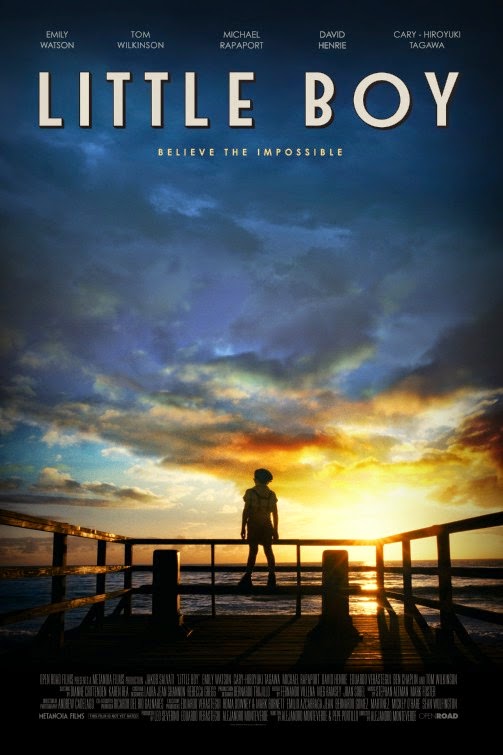 A little boy in small town America during WWII seeks to do whatever it takes to bring his father back safely from the war, and discovers the power of faith to move mountains.
This movie is coming out in April. I got a chance to see an early screening. Keep your eye out for it. It’s the movie that the Oscar nominated Boyhood should have been.
Written and directed by Alejandro Monteverde, the guy who gave us the wonderful adoption story, Bella, and his co-writer Pepe Portilla, this heartwarming family film is actually great storytelling for all moviegoers, not merely those who prefer family-friendly movies. It is so much more than that.
Pepper Flynt Busbee is a seven year old boy in an American town who is so small for his age, he gets teased and bullied and called, “Little Boy.” Even his bigger brother, London, doesn’t appreciate him. Only Pepper’s father, James, treats the kid with dignity. In fact, he loves him with special favor because he sees the big heart and soul of his little boy. They virtually live within imaginative stories in the comics and movies. It’s a touching portrayal of the love of a father and son. And we hear a common phrase between them that becomes a thematic handle for the film, “Do you believe you can do this?” “I believe I can do this!”
When big brother London is drafted into the army for WWII, he is rejected for flat feet, and some kind of law then requires the father of the family to take his place. The dad, James goes into the war to fight, and we follow Little Boy’s anxious desire for his father to come back as the war rages on.
A single elder Japanese man, Hashimoto, lives in the town after being freed from the Japanese internment camps. He becomes the recipient of hostility and bigotry of the residents, including the Busbee family, whose father becomes missing in action against the Japanese war machine in the Philippines. Pepper’s own bullied experience becomes a touchpoint of connection between these two who begin a rocky friendship at the behest of the local priest, Father Oliver.
What I liked about this story was that it dealt with the sensitive subject of racism but with fair nuance that took into account an understanding of the perspective of those whose loved ones where in the War. In an insightful moment of cultural connection, Hashimoto tells a story to Pepper that is a Japanese version of the David and Goliath story that Pepper draws inspiration from. There is always some point of contact in every culture with the truth of God.
 But I also thought that it deals with faith in a unique and thoughtful way, not usually seen in movies. Pepper thinks he can use the magic power of his comic book hero, the Magician, to bring back his dad from the War. The priest tells him it’s a lot like faith, but that the Bible tells us that our faith won’t work if we have the slightest bit of hatred in our hearts. He then gives Pepper a list of good works to do that includes feeding the hungry, clothing the naked, and making friends with Hashimoto.
Though this is a distinctly Roman Catholic sensibility of faith and works, it finds a pretty good balance between the faith and works divide of Protestants and Catholics. I don’t think there is much here for Protestants to get offended by.
The Bible does say after all that faith without works is dead (James 2:14), as well as “If anyone says, “I love God,” and hates his brother, he is a liar; for he who does not love his brother whom he has seen cannot love God whom he has not seen.” (2 John 4:5).
The story wrestles with this faith in a genuine way. You don’t have to agree with all of this story’s depiction of faith in order to draw from its insightful lessons of the human condition. Rather than the typical Hollywood movie notion of faith as being rooted in the believer, this story makes the point that we don’t always get our way, and that God says, “faith can move mountains, but ultimately, it’s up to the Mover,” not us. In other words, God answers prayer, but not always the way we want. This is contrasted with Hashimoto’s belief that Pepper should have faith in himself, but even Hashimoto learns a lesson of faith at the feet of this child as unexpected surprises continue to delight the Busbee family and the viewers of this thoughtful heartwarming story.
I was amazed at how this South American filmmaker was able to capture Americana with such profound and emotionally moving incarnation. He even had Norman Rockwell homages in some of his scenes. But then, Americana is not really a nationalistic or racial identity like other countries, but a set of values and ideas that are universal: Freedom, family, faith, forgiveness, and fighting bullies.
There is also a powerful theme of substitutionary atonement that echoes through this film, another powerful element of a Christian worldview that can best be understood through dramatic emotional narrative. I won’t ruin it by spelling it out other than to say that from the beginning when father substitutes for son in the war, until the end, the Christian notion of people sacrificing for each other by bearing their suffering or punishments is a truly memorable theme that will make this film last not only in your memory days after you’ve seen it, but will be something that beckons for multiple viewings.
My only complaint was a small factual inaccuracy that was a minor point in the film but important to me personally, having studied this time period of WWII. The story goes through to the end of the war and includes the atomic bomb. At one point, we learn that the Japanese might kill all Allied prisoners in retaliation for Hiroshima. This reminds me a bit too much of modern day blame-shifting of Islamism’s evil as a reaction to so-called “western imperialism.” Much like Islam’s centuries’ prior dedication to conquering the world has nothing to do with American foreign policy, so the Japanese plan to kill all prisoners had nothing to do with America’s dropping the Bomb. It was in their Bushido code for generations prior that prisoners did not deserve to live. It was Imperial Japan’s sick and twisted ideology of racist superiority that had long driven their worldview to kill prisoners. But I chalk that up to political naivete, not malice. This minor flaw is almost nothing compared to the positive heart stirring family values the film reinforces in a wonderfully told story.
Little Boy is one of those rare movies made by Christians that is not a bad movie. It’s a great movie with Christian meaning. The Executive producers Roma Downey and Mark Burnett, who also produced the huge TV hit series The Bible and the movie hit The Son of God, seem to be the new Babe Ruth of Christian filmmaking. This movie is another home run.