
Christ’s Descent into Hades (Part 1)
With Easter coming, it’s time we re-examined just what happened on those two days before Jesus rose from the dead.
And the biblical answer is freaky.
One of the most difficult and strange passages in the New Testament is 1 Peter 3:18-22. It’s oddity approaches that of Genesis 6:1-4 that speaks of the Sons of God mating with the daughters of men in the days of Noah and breeding Nephilim giants that lead to the judgment of the Flood.
Perhaps its oddity is tied to the fact that it is most likely connected directly to Genesis 6 and therefore of particular importance for the Biblical Cosmic War of the Seed.This 1 Peter 3 passage is notorious for its difficult obscurity and lack of consensus among scholarly interpretation. Views are divided over it with a variety of speculative interpretations to pick from. So, let’s take a look at it more closely with an attempt to clarify its meaning.
1 Peter 3:18–22
For Christ also suffered once for sins, the righteous for the unrighteous, that he might bring us to God, being put to death in the flesh but made alive in the spirit, in which he went and proclaimed to the spirits in prison, because they formerly did not obey, when God’s patience waited in the days of Noah, while the ark was being prepared, in which a few, that is, eight persons, were brought safely through water. Baptism, which corresponds to this, now saves you, not as a removal of dirt from the body but as an appeal to God for a good conscience, through the resurrection of Jesus Christ, who has gone into heaven and is at the right hand of God, with angels, authorities, and powers having been subjected to him.
The context of this letter is the suffering of believers for their faith under the persecution of the Roman empire (3:13-17). Peter is encouraging them to persevere in doing good despite the evil done against them because they will be a witness to the watching world just as Christ was in his suffering. He then launches into this section as an analogy of what Christ did for us in his journey of suffering, death, resurrection, and ascension.The questions begin to pile up:
When did Christ go on this journey? (v. 18)
Who are the spirits? (v. 19)
Where did he go to proclaim to the spirits? (v. 19)
What did he proclaim? (v. 19)
Where is this prison that they are in? (v. 19)
I believe the answers to these questions are very much in line with the storyline of the War of the Seed. I will try to answer the first three in this post and tackle the last two in the next one.
When Did Christ Go on His Journey?
When Christ “went” to proclaim to the spirits in prison, it says he was “put to death in the flesh but made alive in the spirit, in which he went…” In the original Greek, “he went” does not contain a notion of direction as in ascent to heaven or descent to hell. It can only be determined by the context.[1] So let’s look at that context.Some scholars interpret this being “made alive in the spirit” as a reference to the physical resurrection of Christ from the dead, repeated later in v. 21. As Bible commentator Ramsey Michaels says, “the distinction here indicated by “flesh” and “Spirit” is not between the material and immaterial parts of Christ’s person (i.e., his “body” and “soul”), but rather between his earthly existence and his risen state.”[2]
Scholar William Dalton argues that the idea of being made alive in the spirit was a New Testament reference to the resurrection of Christ’s physical body by the power of the Holy Spirit, not a reference to Christ’s disembodied soul.[3] He writes, “General New Testament anthropology insists on the unity of the human person. Terms such as “flesh” and “spirit” are aspects of human existence, not parts of a human compound. Bodily resurrection is stressed, not the immortality of the soul.”[4]This venerable interpretation sees Christ proclaiming to the spirits as a resurrected body, sometime before he ascended.
Another scholarly interpretation is that Christ’s journey of proclamation occurred in a disembodied state between his death and resurrection. While his body was dead for three days, his spirit was alive and in Sheol. This understands the flesh/spirit distinction as a conjunction of opposites. “Put to death in the flesh but made alive in the spirit” is not talking about the fleshly death and fleshly resurrection, but a fleshly death and a spiritual life. The “spirit” in which he was made alive in this view is not the Holy Spirit, but rather his disembodied soul in the spiritual realm. That “spirit” then corresponds to the “spirits” to whom he proclaimed in the very next verse (v. 19).
This view that Christ’s soul or spirit went down into the underworld of Sheol between his death and resurrection is the most ancient and most traditional view, as attested in the Apostle’s Creed.[5] The Greek for “made alive” is never used of Christ’s physical resurrection in the New Testament, but it is used of the spiritual reality of the believer “being made alive” in Christ (Eph. 2:5-6).[6]Christ suffered the spiritual death of separation from the Father when he died on the cross (Isa. 53:4-6; 1 Pet. 2:24; Matt. 27:46). How the second person of the Trinity can experience separation from the Father remains a Biblical mystery. But in this interpretation, it is Christ’s disembodied spirit that makes the journey to proclaim to the spirits, not his resurrected body.
But whether Christ proclaims in his resurrected body or in his immaterial spirit, the next question arises, who are the spirits to which he proclaims and where are they?
This will be fascinating to you…
Who are the Spirits in Prison?
The identity of the spirits has been debated extensively and falls into four possible categories: Human spirits, demons, Watchers, or a combination of the above.
John Elliott debunks the notion that “spirits” refers to human beings by looking at the Greek word for spirits (pneuma) in Biblical and Intertestamental texts. He concludes, “use of ‘spirits’ for human beings is very rare, and even then it is always qualified. In the Bible and related literature, when reference is made to deceased humans in Hades or the underworld, the term used is not pneuma but psyche.”[7]
But another commentator, Ramsey Michaels, shows that “spirits” (pneuma) is used of demons frequently in the New Testament for those supernatural beings that Jesus often confronted in his ministry.[8] He points out that in 1 Enoch, pneuma is used of demons as the surviving part of the giants killed in the Flood.
1 Enoch 15:8-10
But now the giants who are born from the (union of) the spirits and the flesh shall be called evil spirits [pneuma] upon the earth, because their dwelling shall be upon the earth and inside the earth. Evil spirits [pneuma] have come out of their bodies…They will become evil upon the earth and shall be called evil spirits [pneuma].
In this view, the “spirits in prison” are therefore the demonic souls of the Nephilim that are restricted to the prison “holding cell” under the earth until the coming of Messiah. (See below for the definition of “prison” as a holding cell). As 1 Enoch 15:10 reasons, “The dwelling of the spiritual beings of heaven is heaven; but the dwelling of the spirits of the earth, which are born upon the earth, is in the earth.”
But what of the angelic Watchers? Are they ever referred to as “spirits”? As the 1 Enoch 15 passage above shows, the spirits of the Nephilim hybrids comes from their angelic Watcher progenitors who are also called spirits. In verse 4 of that passage, Enoch condemns the Watchers for violating their heavenly being as spirits (pneuma) and defiling themselves with “the blood of the flesh begotten children.”
The Intertestamental book of Jubilees that drew from 1 Enoch also concurs with the spirits being fallen angels:
Jubilees 15:31-32
over all of [the nations God] caused spirits to rule so that they might lead them astray from following him. But over Israel he did not cause any angel or spirit to rule because he alone is their ruler.
The only New Testament Scriptures that speak of imprisonment of spirits are Jude 6 and 2 Peter 2:4, the very passages that most scholarship has revealed are literarily dependent on the book of 1 Enoch.[13]
| Jude 6 (NASB95) And angels who did not keep their own domain, but abandoned their proper abode, He has kept in eternal bonds under darkness for the judgment of the great day |
2 Peter 2:4 God did not spare angels when they sinned, but cast them into hell [Tartarus] and committed them to chains of gloomy darkness to be kept until the judgment… |
1 Enoch 12:4; 10:12 the Watchers of heaven who have abandoned the high heaven, the holy eternal place … bind [the Watchers] for seventy generations underneath the rocks of the ground until the day of their judgment. |
Jude not only quotes Enoch outright in Jude 4, but throughout his entire letter, he follows the progression of ideas in 1 Enoch and references memes and motifs of the angelic Watchers’ sin and judgment in that ancient text.[14] 2 Peter 2 is considered a paraphrase of Jude with the addition of the word for Tartarus as the description of the location of punishment.
Tartarus was well known by the ancients as the lowest place of the underworld where the Titans were bound in pagan mythology. That underworld was referred to as Hades (Greek) or Sheol (Hebrew), and has obvious conceptual links to Jude and Peter’s location of punishment (more on Tartarus and Sheol later).[15]It would make most sense that Peter’s second letter about angels bound in the prison of Tartarus would have continuity with the “spirits in prison” he is writing about in this first letter.
Dalton enumerates, “A survey of 1 Enoch reveals a striking and obvious parallel to 1 Pet 3:19–20. In this latter text we have 1. a journey of Christ, 2. a proclamation, 3. to the spirits, 4. in prison, 5. who rebelled, or disobeyed, 6. in the setting of the flood. Now it is precisely in 1 Enoch that we find all these elements bound together in the closest unity.”[19]
The spirits are specifically indicated as being those who were disobedient during “the days of Noah while the ark was being prepared.” That “days of Noah” is exactly the time period that 1 Enoch speaks of the fallen Watchers and their giant progeny receiving their comeuppance with a binding in Tartarus/Sheol at the Flood.[20]
Wink explains that the ancient mind of the Biblical writers was steeped in a macrocosm/microcosm of “what is above is also below.” “Angelic and demonic activity in heaven was reflected in events on earth…These Powers are both heavenly and earthly, divine and human, spiritual and political, invisible and structural.”[22]
Reicke adds that the “fallen Angels… the Powers, the demons in general, can in a certain way represent the whole world of fallen angels.”[23] And Pierce concludes, “the distinction between cosmic and earthly sinners is so blurred they cannot be distinguished.
1 Peter 3:22 concludes that the context of the proclamation Christ made was the subjugation of “angels, authorities, and powers.” Heavenly “principalities, powers, and authorities” is a recurring concept in the New Testament (Col. 1:16, 2:13-15; Eph. 1:20-23). It is a concept that assumes earthly rulers and powers are animated and empowered by spiritual or cosmic rulers and power behind them.
Thus, Paul could encourage those Christians who were suffering from the earthly rulers and powers who persecuted them; “For we do not wrestle against flesh and blood, but against the rulers, against the authorities, against the cosmic powers over this present darkness, against the spiritual forces of evil in the heavenly places” (Eph. 6:12-13). In other words, the real enemies of the persecuted Christians were the spiritual powers behind their earthly persecuting powers. This is not a denial of the human evil, but rather a drawing back of the curtain to see the ultimate enemy with more clarity.
These spiritual and earthly “powers, rulers, authorities, and thrones,” are the Seed of the Serpent that had been involved in the cosmic War of the Seed against Messiah. It is these rulers, both heavenly and earthly, who did not understand the mystery of the Gospel of redemption through Messiah’s suffering. They thought that killing the Chosen One, the Messiah, would bring them victory.
1 Corinthians 2:7–9
But we impart a secret and hidden wisdom of God, which God decreed before the ages for our glory. None of the rulers of this age understood this, for if they had, they would not have crucified the Lord of glory.
So the focus on “powers and authorities” stresses the nature of Christ’s cosmic mission against the heavenly powers.
But was this prison really in Hades, the underworld abode of the dead? Was that just a mythical construct without any modern relevance? And what did Christ proclaim to them? The Gospel or something else? You’ll find out in the next post.
For additional Biblical and historical research related to this novel, go to the Research page on Godawa.com.
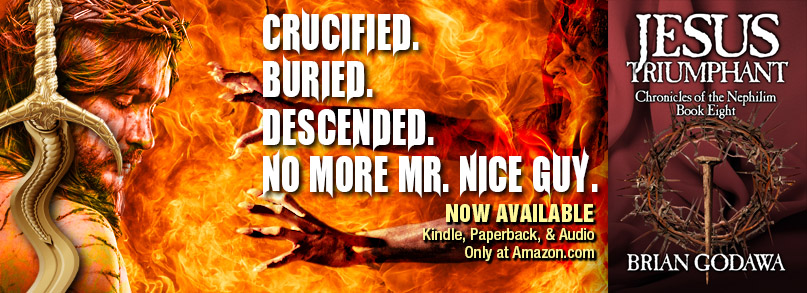
To get the novel Jesus Triumphant, about what happened during Christ’s trip to Hades, get it in kindle, paper, hardcover, audiobook or Large Print exclusively here at Amazon.
