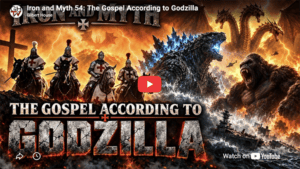
The Gospel According to Godzilla. Chaos Monsters in the Bible.
Let me detonate your childhood: the Bible is a monster movie, and Godzilla is straight out of Scripture. Crack open Job 41 and read the description of Leviathan — scales like rows of locked shields, flaming torches shooting from his mouth, smoke pouring from his nostrils, sparks leaping off his body. That’s not a dinosaur. That’s a fire-breathing, plate-backed sea dragon three thousand years before Toho Studios ever stuck a man in a rubber suit.
Tolkien lifted it for Smaug. Hollywood’s been cashing checks on it ever since. And here’s the part the church doesn’t want to touch: the Canaanites had a Leviathan too — they called him Lotan, a seven-headed twisting serpent, the exact same beast, sitting in pagan myth right alongside Babylon’s Tiamat, Egypt’s Apophis, and every storm-god-slays-the-dragon story ever told.
A lot of Christians panic at that overlap. They shouldn’t. It’s not a scandal that Babylon and the Bible share a dragon. It’s the fingerprint of one true story stamped onto every civilization that ever looked in fear at the untamed chaos of the sea and the wilderness.
And Hollywood is still preaching it; they just moved the altar to the box office. Godzilla dies and refuses to stay dead, jump-started back to life with a nuclear warhead in King of the Monsters — exactly like the Leviathan Scripture keeps killing yet swears to slay again at the end of days (Psalm 74:13-14; Isaiah 27:1).
The Monsterverse literally christened its beasts Behemoth, Leviathan, Tiamat, Abaddon, Baphomet, Quetzalcoatl — thirty-four of them ripped from the world’s religions.
And they staged Godzilla’s abyssal lair as a ziggurat flanked by cherubim throne-guardians, and sent the three-headed storm-dragon Ghidorah descending inside a category-six hurricane like Satan falling as lightning.
Pacific Rim funnels interdimensional titans through a rift in the deep, beings “who kept not their first estate.”
Jurassic Park dares to ask who the real monster is — the T. rex, or the man who raised it from the dead.
Jaws is Leviathan stripped naked of the supernatural, pure man-versus-sea.
The Thing, Mimic, Tremors, Gremlins, Cocaine Bear, King Kong, and Clash of the Titans with its Kraken laying siege to biblical Joppa — every last one is wrestling the same ancient terror.
Because the drive to fight the dragon and drag order out of chaos isn’t a marketing formula. It’s the cultural mandate branded into your soul: subdue the monster, or be devoured by it.
The chaos monsters aren’t literal creatures but a literary and theological genre — a covenantal image. The sea, the river, and the desert wilderness function throughout Scripture as symbols of chaos, the untamed and unknown world where sin dwells, and the monster is the personification of that chaos.
Leviathan is the beast that Yahweh pushes back and crushes in order to establish His created order, whether that’s the order of creation itself or the order of the covenant.
Which is why Psalm 74 deliberately fuses creation language with covenant language. God shatters the heads of Leviathan at the Red Sea and then leads Israel to Sinai, to establish the heavens and earth (see also Isaiah 51:9-16).
Leviathan is imaginative rather than a real animal precisely because he gets killed over and over across the texts, yet is still slated for a future slaying — a recurring symbol rather than a single dead beast.
And this order-versus-chaos struggle isn’t a Hebrew invention but a primal religious concept written into every culture on earth, which is exactly why it keeps resurfacing in our monster stories: these movies tap a deep root in human nature and our God-given cultural mandate to subdue chaos and bring forth order.
So the next time you watch a hero drag order out of a rampaging monster, know that you’re not just being entertained — you’re watching a shadow of the God who split the sea, crushed Leviathan’s heads, and has been turning chaos into kingdom since the first verse of Genesis.
Watch the full discussion. Our regular Iron and Myth panel: Derek Gilbert (host); Dr. Judd Burton (BurtonBeyond.net); Doug Van Dorn (DouglasVanDorn.com); and Brian Godawa (Godawa.com).