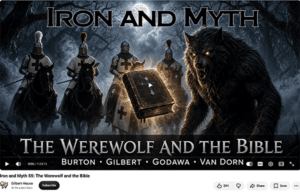
Where Does the Man End and the Beast Begin? Werewolves in the Bible and Movies.
Here’s a skin-crawling truth: the werewolf isn’t a campfire story — it’s you. It’s me. Strip away the silver bullets and the full moons and what you’re left with is the oldest Christian doctrine on the books: original sin, the beast clawing inside every single human being that no willpower can cage.
That’s why the 1941 Wolf Man still haunts us — “even a man who is pure in heart and says his prayers by night may become a wolf.” Nobody’s immune. It’s Romans 7 with fangs: doing the very evil you hate and unable to stop. Dr. Jekyll and Mr. Hyde is the most Christian werewolf tale ever written, and The Island of Dr. Moreau is right behind it — man giving in to the feral thing underneath the skin.
And the church fathers knew it was real. Augustine devoted paragraphs of The City of God to the werewolf phenomenon and concluded that if it’s genuine, it’s demonic — a man’s body lying lifeless while his spirit manifests to others in the shape of a beast.
This isn’t superstition the Bible outgrew. It’s a monster the Bible diagnosed.
And it’s crawling all through Scripture if you have eyes to see it.
Nebuchadnezzar — the most powerful king on earth — gets cursed by the direct decree of the Watchers in Daniel 4, driven into the wild to eat grass like an ox until his hair grows like feathers and his nails become claws.
Scholars connect that bird-and-claw imagery straight to the underworld and to Enkidu, the shaggy wild-man of the Epic of Gilgamesh.
The lesson is brutal and unmistakable: when rulers reject God, He strips the image of God out of them and they become beasts — which is exactly why every evil empire in Daniel shows up as a hybrid monster, a lion with wings, an unholy mixture.
Then there are the Ariels, the “lion-men of Moab” that Benaiah strikes down in 1 Chronicles 11:20-25 — Is that just poetry for “fierce warriors” like lions? Or does the context having to do with giants mean he is talking about monsters beyond humanity (with 1 Chron. 11:10-14; 20:4-8)?
Your English Bible buried these beast-men under safe translations. The Hebrew didn’t.
Now watch what Hollywood has done to the monster, because it exposes exactly where our culture is heading.
In the old films the curse was a horror — Lon Chaney Jr. and Benicio del Toro’s Wolfman recoil from what they’ve become, Josh Hartnett’s character in Penny Dreadful begs to be chained up, thus retaining that older view.
But flip to An American Werewolf in London and the religious overtones vanish entirely; by The Howling the werewolves run a support group recruiting new members; and in Twilight, The Vampire Diaries, Being Human, and Underworld the monster is reframed as a sexy, misunderstood identity the world just needs to learn to get along with.
That’s not a storytelling accident — it’s the normalization of the margin, the pagan return that stopped calling the beast a curse and started calling it liberation. (Obviously, this is not monolithic but illustrating two strands of worldviews)
Some won’t give up the monster because, like James Spader’s character in the Jack Nicholson film Wolf, they love the power — the same thing deliverance ministers report about people who won’t surrender their demons.
Even Teen Wolf played it for laughs: why change back when the beast makes you win?
From Ginger Snaps turning lycanthropy into a puberty metaphor to the Beast of Gévaudan that really terrorized France and killed over a hundred people, the werewolf keeps asking the one question modernity refuses to answer: where does the man end and the beast begin?
The Bible already told you — the beast is what’s left when the image of God is gone.
And here’s the part nobody warns you about: the next time you sing “Onward Christian Soldiers,” remember the pastor who wrote it did so right after crossing a moor haunted by a werewolf.
See the full podcast on Iron and Myth here.